
Contact Us
181 2883 6688
sunny.lin@hanyueint.com
2501,Block A,Building 3,Hengmingwan Chuanghui Center,Longcheng Street,Longgang District,Shenzhen
On March 11 local time, the Office of the United States Trade Representative (USTR) issued a formal notice on initiating Section 301 investigations, stating that the United States will launch Section 301 investigations against 16 trading partners including China, the European Union, Mexico, Vietnam, India and Japan.
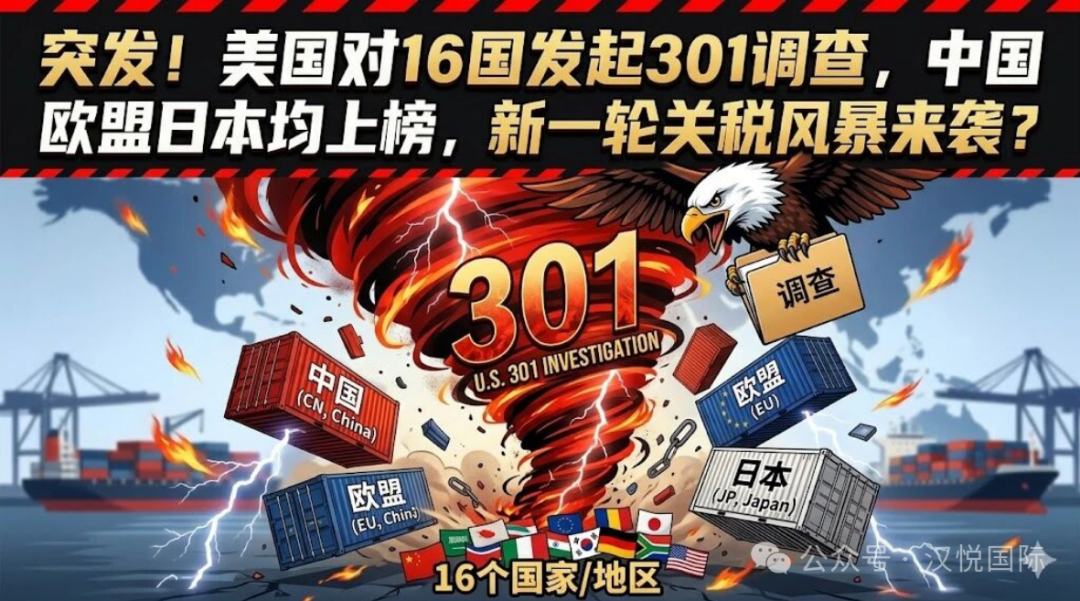
The so-called "Section 301 investigation" originates from Section 301 of the US Trade Act of 1974. This section authorizes the US Trade Representative to launch an investigation into "unreasonable or unjust trade practices" of other countries and, upon conclusion of the investigation, recommend to the US President the imposition of unilateral sanctions. This investigation is initiated, investigated, adjudicated and enforced by the US itself, bearing a strong unilateralist tint. Previously, the US has imposed tariffs ranging from 7.5% to 25% on over 300 billion US dollars worth of Chinese goods exported to the US based on this section.
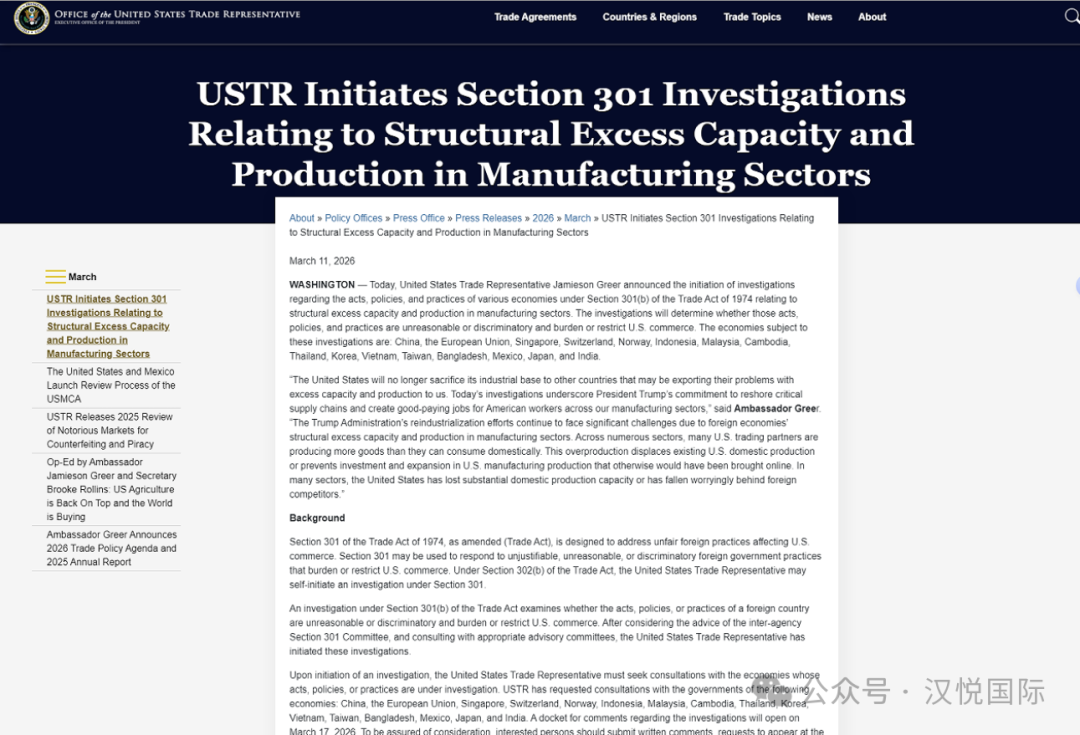
U.S. Trade Representative Jamie L. Greer said that the investigation might reach a conclusion before the summer of this year and did not rule out the possibility of imposing new tariffs on some trading partners. According to the published schedule, the investigation process was initiated on March 11, the public comment submission channel was opened on March 17, the deadline for written comments and hearing applications was April 15, public hearings would be held from May 5 to 8, and then the process would move into the stage of supplementing and evaluating comments.
Core of the event: List of 16 countries has been released, and China is included.
According to the announcement by the Office of the United States Trade Representative, the 16 trading partners included in the 301 investigation are:
Asia: China, Japan, South Korea, India, Vietnam, Thailand, Malaysia, Indonesia, Cambodia, Bangladesh, Singapore Europe: European Union (as a whole), Switzerland, Norway
America: Mexico
Others: Taiwan Region (a province of China)
It is worth noting that Canada, the second-largest trading partner of the United States, was not included in the list, while the European Union as a whole was subject to the investigation.
The US side claims that these countries have caused "overcapacity" in key industries (such as automobiles, batteries, solar panels, steel, electronic products, etc.) through government subsidies and lowering workers' wages, thereby harming the interests of American producers.
Replacement of old tariffs: Countdown to 150-day window period
The initiation of this 301 investigation was directly triggered by a historic ruling made by the US Supreme Court on February 20th - with a 6:3 vote, it was determined that the "reciprocal tariffs" imposed by the Trump administration under the International Emergency Economic Powers Act (IEEPA) lacked explicit authorization from Congress and were therefore unconstitutional.
To fill this "tariff gap", the Trump administration quickly invoked Article 122 of the 1974 Trade Act and imposed temporary tariffs of 10% on goods from around the world for a period of 150 days. This 301 investigation is aimed at completing the legal groundwork for a new round of tariff measures before the temporary tariffs expire on July 24.
U.S. Trade Representative Grier clearly stated that his team will strive to complete the investigation within the 150-day window period, and the final tariff rate will be determined after the investigation is completed.
Multiple responses: Strong opposition sentiment is on the rise
In response to the renewed offensive of American unilateralism, several trading partners promptly took action:
On the 12th, Chinese Foreign Ministry Spokesperson Guo Jiakun stated that China's position on handling Sino-US economic and trade issues is consistent and clear. China opposes all forms of unilateral tariff measures. "A tariff war and a trade war do not benefit any party. Both sides should resolve relevant issues through negotiation on the basis of equality, respect and mutual benefit. The so-called 'overcapacity' is a false proposition. China opposes using this as an excuse for political manipulation."
Regarding the EU side, the chairperson of the Trade Committee of the European Parliament, Lange, stated on the 12th that the EU will only accept the new round of tariff measures that "reproduce" the trade agreement reached by both sides in Scotland last year. Any deviation is "unacceptable".
Japan has made a request to the United States, hoping that the new measures will not be more detrimental than the 2025 Japan-US agreement. During a meeting with the US Commerce Secretary in Washington last week, Japanese Minister of Economy, Trade and Industry Akira Kishizawa clearly demanded that the US not raise tariffs to levels beyond those agreed upon in the previous bilateral agreement.
The Blue House in South Korea responded on the 12th, stating that the South Korean side will actively engage in negotiations with the US to strive for treatment no worse than that of other major countries. However, many South Korean media criticized the US's trade policy for showing a clear tendency where "political logic prevails over economic logic".
The Ministry of Commerce of Thailand promptly established a working group to deal with the "301 investigation". The director of the Foreign Trade Department of the Ministry of Commerce, Arada, stated that they will promptly initiate negotiations and thoroughly prepare the relevant documents.
From the IEEPA to Section 122, from "reciprocal tariffs" to the 301 investigation - the United States is using a "legal relay" to maintain its unilateral trade barriers. Han Yue International will closely monitor policy developments, while also making preparations for alternative markets and backup supply chains in advance to maintain flexibility. Optimize market layout, preset alternative solutions, so that shippers can remain resilient and flexible in the face of fluctuations. If you need the latest information or customized response plans, please contact our customer service.