
Contact Us
181 2883 6688
sunny.lin@hanyueint.com
2501,Block A,Building 3,Hengmingwan Chuanghui Center,Longcheng Street,Longgang District,Shenzhen
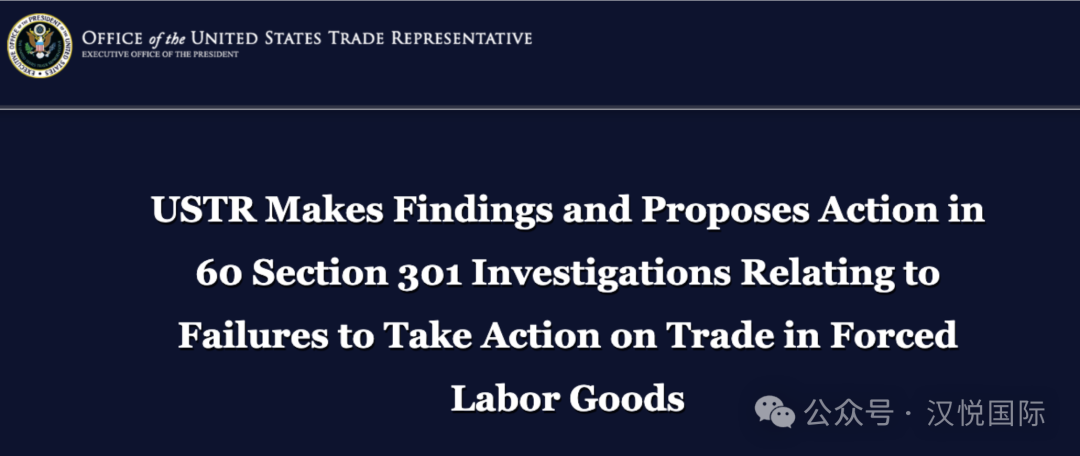
On June 3, 2026, the U.S. Trade Representative's Office (USTR) released a Section 301 investigation notice titled "Findings and Proposed Measures Regarding Countries/Regions That Have Failed to Implement and Effectively Enforce Bans on Importing Goods Made with Forced Labor," announcing plans to impose additional 301 tariffs of 10% and 12.5% on imports from 60 economies—including China, Japan, India, South Korea, and Vietnam—on the grounds that these economies have "failed to implement and effectively enforce bans on importing goods made with forced labor," thereby meeting the criteria for punitive tariff measures under Section 301.
The announcement stated that the U.S. government has completed its Section 301 investigation into 60 economies for "failing to establish or effectively enforce bans on imports of goods produced using forced labor," and has preliminarily determined that these practices constitute "unreasonable trade practices" that harm U.S. commercial interests. Based on the findings, the USTR intends to impose new Section 301 tariffs on goods from these economies entering the United States and will initiate a public comment process.
This investigation covers 60 economies, including China, India, Japan, South Korea, Singapore, Vietnam, Thailand, Malaysia, the United Kingdom, Australia, Brazil, Saudi Arabia, and the United Arab Emirates. Among them, 54 economies were found not to have established or effectively enforced import bans on products made with forced labor. Six economies—Canada, the European Union, Mexico, Indonesia, Pakistan, and Ecuador—were identified as having established relevant systems but lacking sufficient enforcement.
Under the USTR proposal, the United States plans to impose an additional 10% Section 301 tariff on six economies that have already established or committed to establishing bans on imports of goods made with forced labor.
For the other 54 economies, an additional tariff of 12.5% is proposed.
In addition, the United States plans to establish a special mechanism for textiles and apparel products, allowing certain imported goods to be subject to lower tariffs.
U.S. Trade Representative Jamieson Greer stated, "The United States will not continue to tolerate trade partners gaining unfair competitive advantages due to forced labor issues. He believes this situation forces American businesses and workers to compete globally with low-cost products made using forced labor, undermining a fair trading environment."
According to the schedule, interested parties must submit requests for a hearing by June 22, 2026, and file written comments by July 6. The USTR will hold a public hearing on July 7. Whether the new round of Section 301 tariffs will be formally implemented, along with the specific scope and rates of taxation, remains subject to further review.
Notably, this marks another large-scale Section 301 investigation launched by the Trump administration since 2026. If implemented, the resulting measures could further expand the scope of U.S. tariffs on global trading partners and potentially reshape global supply chains, manufacturing layouts, and international trade flows.
Six countries and regions proposed for an additional 10% Section 301 tariffs:
Canada, Ecuador, European Union, Indonesia, Mexico, Pakistan.
54 countries and regions proposed for an additional 12.5% Section 301 tariffs:
Exempt products:
The announcement attachment lists the products exempt from the additional tariffs mentioned above, primarily including:
Some agricultural products, such as beef, coffee, spices, and fruits
Medicines, vaccines, vitamins
Chemicals, polymers, rubber, wood
Aircraft and its parts
Some electronic components and optical instruments
Precious metals such as gold and silver
Fertilizers, minerals, paper, textiles, etc.
Products under tariff item 232 mainly include steel, aluminum, copper and their derivatives, as well as automobiles and auto parts.
Compliant goods under the USMCA
Central American Free Trade duty-free textiles, donated books, carry-on luggage, etc.
This is the latest move by the Trump administration to shift toward Section 301 as its primary tariff tool, following the Supreme Court's earlier ruling that certain IEEPA tariffs were unlawful.
This marks the U.S. readiness to broadly impose 301 tariffs on 60 economies worldwide, citing "importation of goods made with forced labor not prohibited."
The aforementioned 301 tariff measures could take effect as early as July.
Affected countries/regions and enterprises may submit comments or request a hearing within the specified period.
The United States' imposition of new tariffs is now a certainty. The only difference lies in the tax rate and the extent of coverage. It is advisable to prepare a plan as early as possible and take effective actions within the window period before July 6th. Every passive increase in costs is a test of the efficiency of the supply chain and the level of operational refinement. Han Yue International will closely monitor policy developments and simultaneously make preparations for alternative markets and backup supply chains to maintain the room for adaptation. Optimize market layout, preset alternative solutions, and enable shippers to maintain flexibility and resilience in the face of fluctuations. If you need the latest information or customized response plans, please contact our customer service.