
Contact Us
181 2883 6688
sunny.lin@hanyueint.com
2501,Block A,Building 3,Hengmingwan Chuanghui Center,Longcheng Street,Longgang District,Shenzhen
Recently, several noteworthy new developments have emerged in the fields of international shipping and trade policy. On the one hand, a nationwide labor action in Belgium may affect port-related customs, pilotage, lock operations, and inland transport services, with the extent of the impact varying by port and service segment; in addition, the nationwide labor action in Belgium has increased uncertainty regarding port pilotage, vessel scheduling, and inland transport, and some vessels may face waiting times and schedule adjustments. On the other hand, the formal AD/CVD orders issued by the U.S. Department of Commerce on November 17, 2026 are formal AD/CVD orders rather than a mere continuation of previously existing orders, and the United States has imposed Section 232 import adjustments on polysilicon, polysilicon ingots, and their derivative products listed in the annex to the notice, under which certain products will be subject to new minimum import prices or tariff arrangements starting December 4.
I. Belgian Labor Action Affects Port Transport, Vessel Schedules Under Pressure at Antwerp and Other Ports
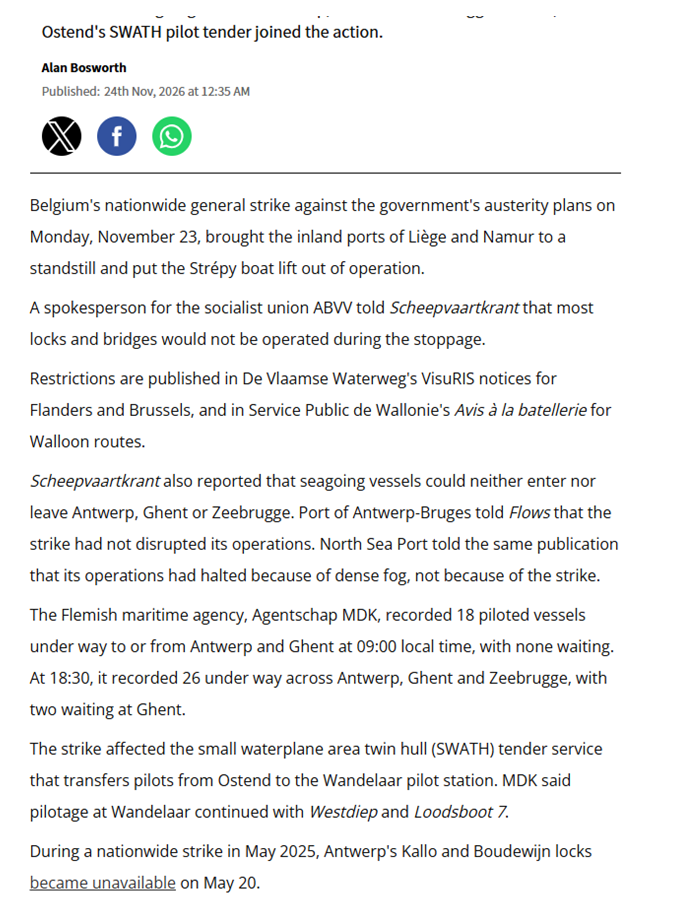
On November 24 local time, a nationwide strike in Belgium affected the Port of Antwerp-Bruges and neighboring ports, disrupting key services such as port pilotage and vessel traffic scheduling. Some industry information indicates that individual locks, bridges, or pilotage services may be subject to restrictions during the labor action; actual operating status should be subject to real-time notices from the port and waterway authorities.
The impact of the strike extends beyond the Port of Antwerp to other Belgian ports including Zeebrugge and Ghent, placing certain pressure on regional port transport and vessel scheduling.
Restrictions on pilotage or traffic scheduling may first affect vessel entry and exit, as well as berthing and unberthing times; whether terminal cargo handling is affected will also depend on specific terminal shifts and the extent of personnel participation.
For import and export cargo involving Belgium and Northern Europe, particular attention should be paid to the following aspects:
-Vessel schedule delays: Increased vessel waiting times may affect originally planned berthing and departure schedules, potentially leading to changes in subsequent voyage connections.
-Terminal operations: The pace of recovery in port operations and vessel scheduling will directly affect cargo handling and terminal operation arrangements.
-Container transport: Schedule changes may further affect import container pickups, export container returns, and related drayage plans.
-Inland transport: Barge, rail, and road connections between Belgian ports and the European hinterland may be indirectly affected.
II. U.S. Trade Policy: Plywood Antidumping Measures Continue, New Tariffs on Solar Products to Take Effect December 4
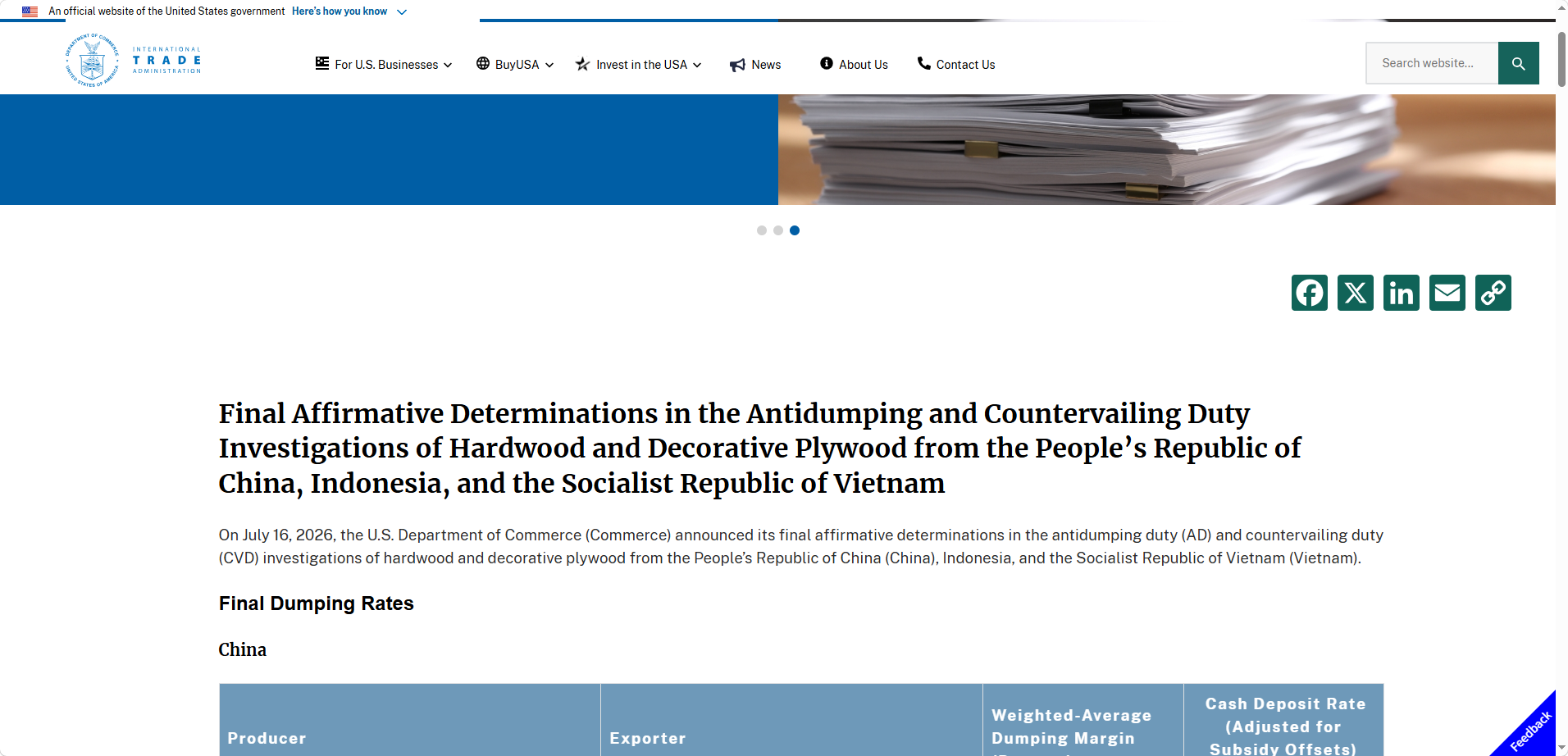
The United States continues to apply antidumping and countervailing measures to hardwood and decorative plywood within the announced scope from China, Indonesia, and Vietnam, while introducing new tariff arrangements for products related to the solar supply chain, further affecting exports of relevant products to the United States and import costs. According to the notice, the antidumping cash deposit rate for China-wide entities is 185.96% after subsidy offset adjustments; certain producers or exporters granted separate rates may be subject to different rates. Relevant goods may also be subject to countervailing duties concurrently, with specific cash deposit rates varying by country, producer, and exporter. Import costs cannot be calculated solely on the basis of the 185.96% antidumping rate.
Effective 12:01 a.m. Eastern Time on December 4, polysilicon ingots and polysilicon derivative products listed in the annex to the notice will in principle be subject to a 15% Section 232 additional tariff, although differentiated treatment may apply depending on the country of origin.
From the same date, the notice also implements a minimum import price mechanism for relevant polysilicon products, with reference levels including USD 21/kg for polysilicon, USD 100/kg for polysilicon ingots and wafers, USD 0.22/W for cells, and USD 0.38/W for modules. Importers need to determine the specific declaration method based on product category and transaction price.
Unless otherwise provided in the notice, Section 232 measures may be applied cumulatively with other applicable tariffs, AD/CVD orders, and fees; the comprehensive import cost cannot be calculated solely on the basis of the additional 15%.
TIPS
European port strikes may cause vessel waiting times, port operation delays, and changes in inland transport connections; U.S. trade policy adjustments may further affect the export competitiveness, import costs, and customs clearance compliance requirements for certain goods. Hanyue International will continue to monitor port operating status, carrier notices, and trade policy changes in various countries, providing customers with timely logistics information and transport solution references.