
Contact Us
181 2883 6688
sunny.lin@hanyueint.com
2501,Block A,Building 3,Hengmingwan Chuanghui Center,Longcheng Street,Longgang District,Shenzhen
Recently, several new developments have emerged in U.S. trade policy and the international logistics market. On November 25, the USTR published Section 301 investigation determinations concerning 14 economies, including China, the EU, Japan, and Vietnam, and proposed planned tariff actions. The relevant proposals remain in the public comment and hearing process and have not yet become formally effective new tariff rates. Meanwhile, rail transfer operations and inland logistics nodes at some U.S. ports continue to face backlogs, insufficient rail capacity, and intermittent chassis shortages. Due to the Thanksgiving holiday on November 26, multiple container terminals in the Los Angeles, Long Beach, New York, and New Jersey areas closed their gates that day. Continued attention should be paid to recent arrangements for container pickup and return, rail transfer, and inland delivery.
I. The United States Announces Findings in 14 Section 301 Investigations and Proposes New Tariff Measures
On November 25, 2026, the Trump administration of the United States announced a new round of trade measures involving 14 trading partners, including China, the European Union, Japan, South Korea, India, Vietnam, Thailand, and Cambodia. Citing issues such as industrial subsidies and manufacturing overcapacity in the economies concerned, the U.S. side initiated a new round of trade investigations and proposed tariff measures on certain imported goods.
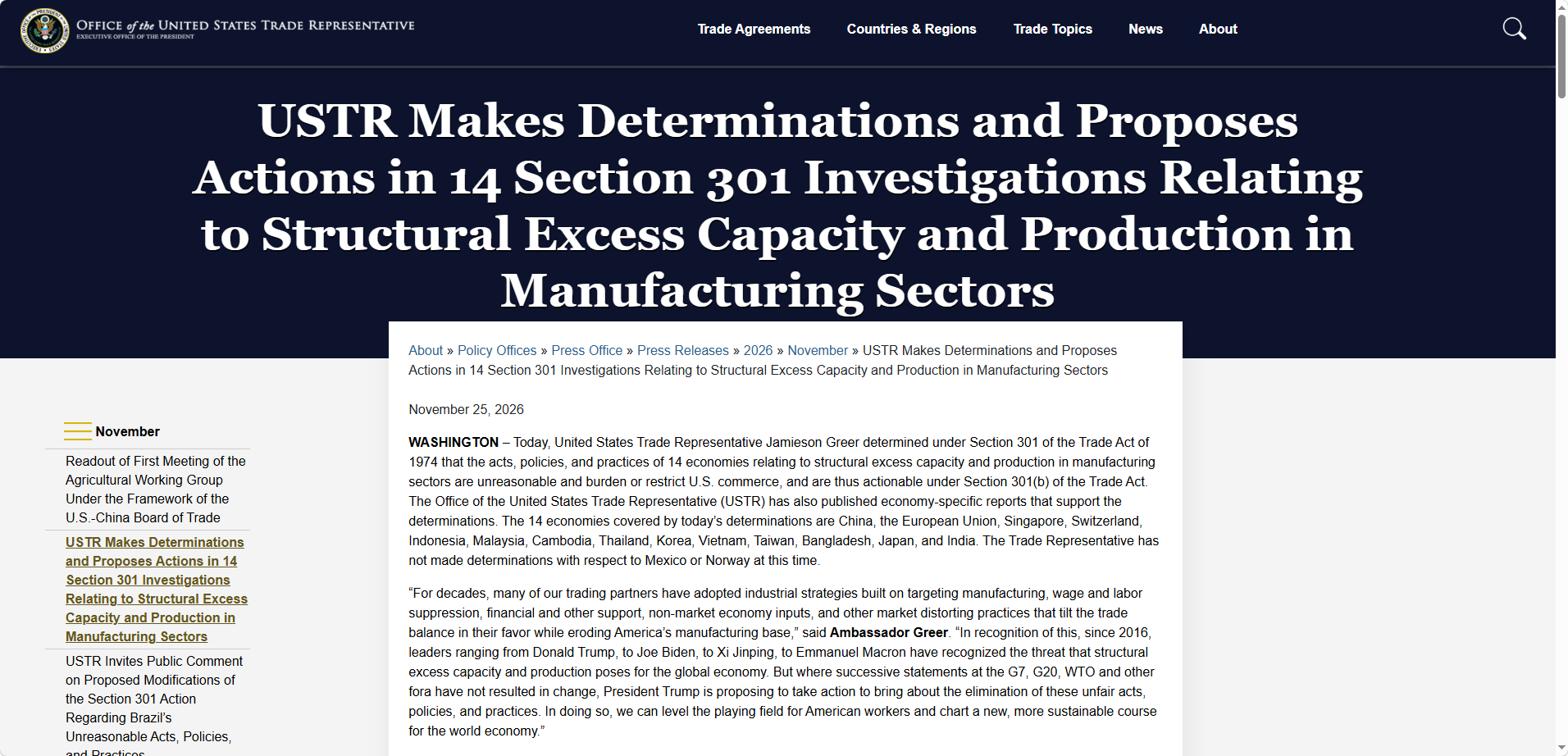
According to the Associated Press, with respect to Chinese goods, the USTR is considering applying a tariff of up to 20% to goods outside the annexes to the relevant notice, a tariff of up to 10% to goods listed in Annex A, and granting exemptions for certain goods listed in Annex B. With respect to EU goods, the USTR is considering combining the most-favored-nation rate and existing Section 301 tariffs so that the applicable rate for the relevant goods reaches 15%, with certain goods potentially eligible for exemption. At present, the relevant rates remain subject to subsequent procedures, and the specific product scope, final applicable rates, and effective dates still require further clarification by U.S. officials. The USTR will accept written comments and requests to participate in hearings until January 5, 2027, and plans to hold hearings beginning January 25, 2027.
Chinese and Southeast Asian enterprises exporting to the United States should monitor the annexes to the proposed notice, HTSUS tariff lines, product descriptions, rules of origin, and final effective dates. It should be noted that the published rates remain subject to subsequent investigation and implementation procedures, and the specific product scope, effective dates, and final rates still require further clarification by U.S. officials. The proposed rates should not at present be regarded directly as new rates already in effect for all relevant goods.
II.The United States Maintains Anti-Dumping (AD) and Countervailing Duty (CVD) Measures on Chinese Plywood
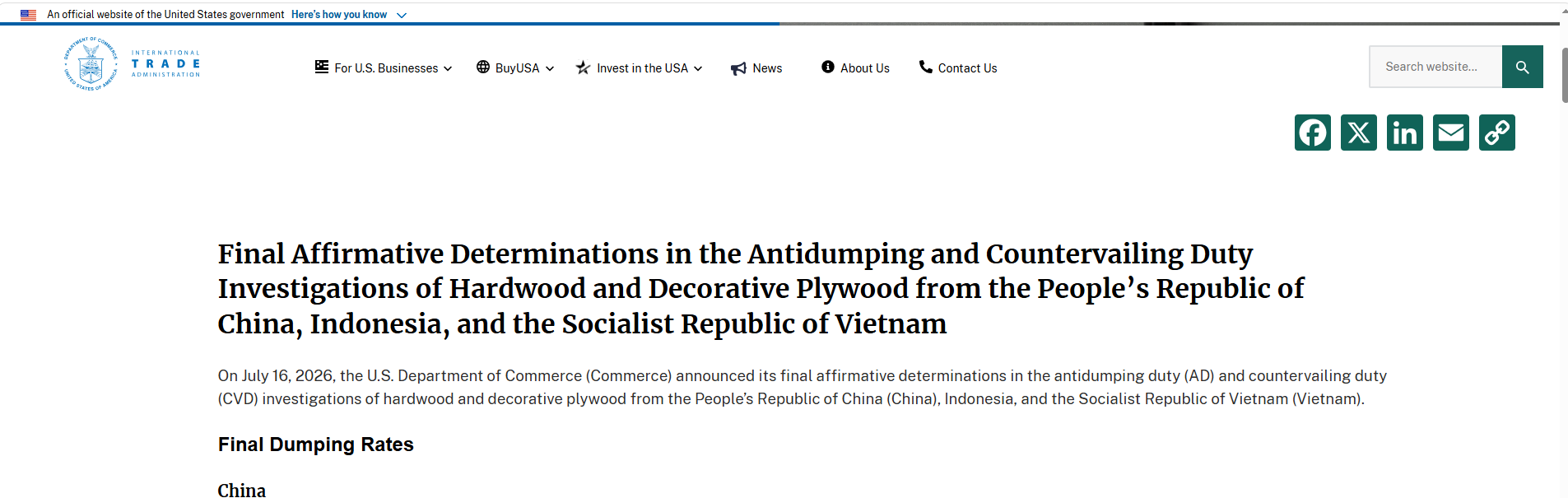
In addition, Chinese exporters of the relevant products should also monitor the existing U.S. anti-dumping (AD) and countervailing duty (CVD) trade measures.
For Chinese hardwood and decorative plywood within the scope of the notice, the China-wide entity and certain companies listed in the notice are subject to an anti-dumping cash deposit rate of 185.96%; the specific application remains subject to verification of the producer, exporter, and the scope of the duty order.
The relevant imported goods may also be subject to a countervailing duty cash deposit rate of 88.96%, but the actual duty liability should be calculated separately based on the producer, exporter, date of importation, and CBP declaration requirements. The AD and CVD rates should not simply be added together.
It should be noted that the plywood AD/CVD measures and the current Section 301 investigation are separate measures and cannot be directly calculated together.
III. The EU Opposes the New U.S. Tariff Measures; EU-U.S. Negotiations on Steel and Aluminum Trade Continue to Advance
On November 25, 2026, the European Commission expressed its opposition to the United States’ latest round of proposed Section 301 tariff measures. The EU stated that, under the previous EU-U.S. trade arrangements, the overall tariff rate on relevant EU exports to the United States should, in principle, remain capped at 15%, and called on the United States to ensure that the proposed measures are consistent with its existing commitments.
EU Trade Ministers are expected to meet with the U.S. Trade Representative on November 30. Additional tariffs on steel, aluminum, and their derivative products are expected to be among the key topics of discussion.
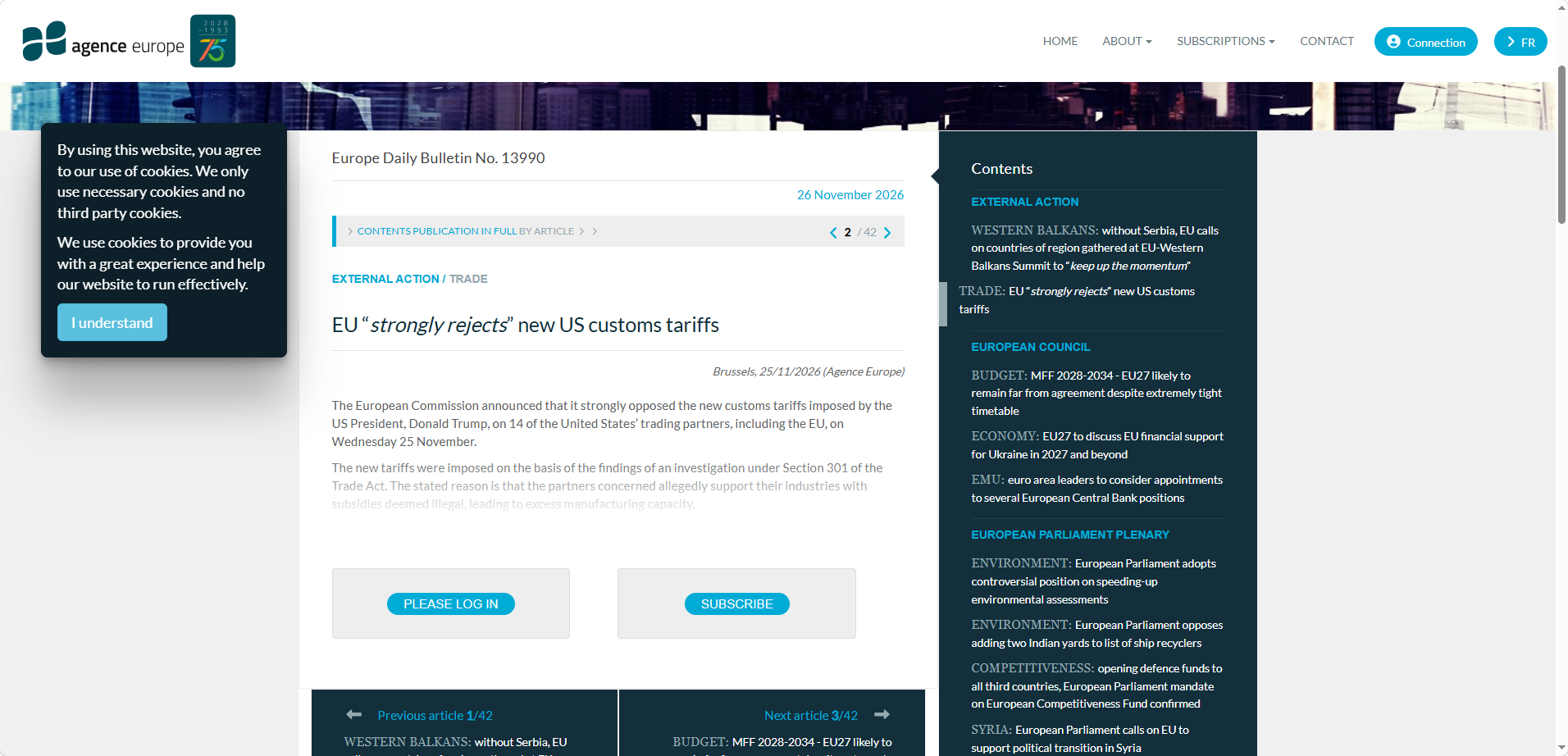
Steel, aluminum, and their derivative products have long been a key area of focus in EU-U.S. trade policy, and the outcome of subsequent negotiations may affect the export costs and trade arrangements for the relevant products. The proposed Section 301 actions and the Section 232 measures on steel and aluminum products are distinct legal mechanisms. In certain country-specific proposals, the USTR has indicated that existing Section 232 and Section 301 duty burdens would be taken into account; therefore, the final cost cannot simply be calculated by directly adding together multiple nominal tariff rates.
IV. Rail Transfer and Inland Nodes at Certain U.S. Ports Continue to Face Backlogs
According to a logistics update issued by SEACO Shipping on November 25, 2026, ports including Houston, Los Angeles/Long Beach, and Oakland in the United States are experiencing rail congestion and intermittent container chassis shortages, and rail transfer operations in Chicago are also facing congestion.
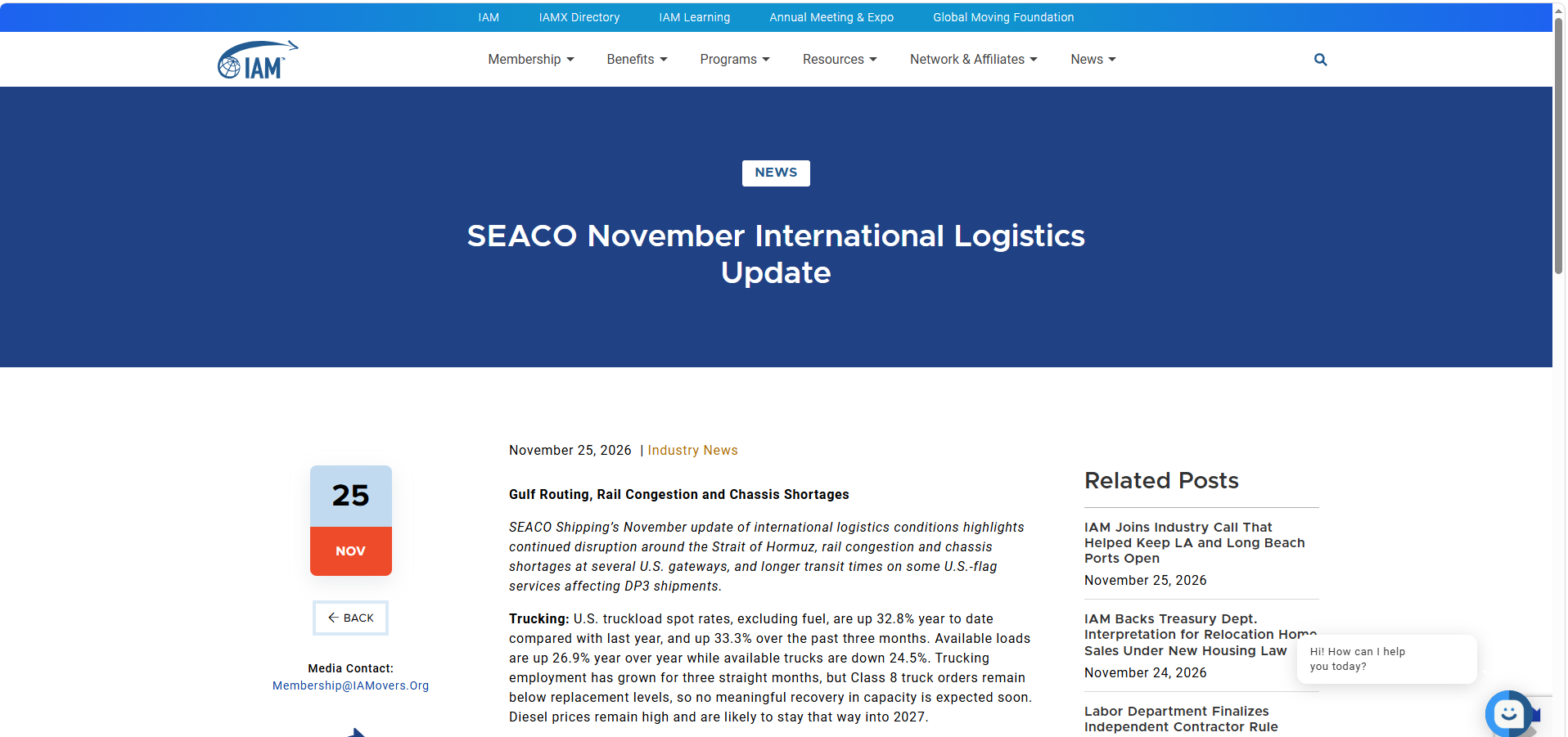
Port congestion, reduced rail transfer efficiency, and insufficient container chassis supply may affect container pickup, rail transfer, and inland delivery timelines. For cargo destined for inland areas of the United States, chassis availability, container pickup appointments, and rail connections should be confirmed in advance, and buffer time should be allowed for transportation.
Recently, attention should be focused on cargo involving the following U.S. ports and inland transportation nodes:
- Port of Los Angeles and Port of Long Beach:Monitor container chassis supply, terminal container pickup appointments, and rail transfer arrangements.
- Port of Oakland:Monitor rail transport connections and container equipment supply.
- Port of Houston:Monitor rail congestion and drayage container pickup efficiency.
- Chicago rail hub:Monitor rail transfer waiting times and inland delivery plans.
V. Multiple U.S. Container Terminals to Close Some or All Gates During Thanksgiving; Container Pickup and Return Arrangements Require Advance Coordination
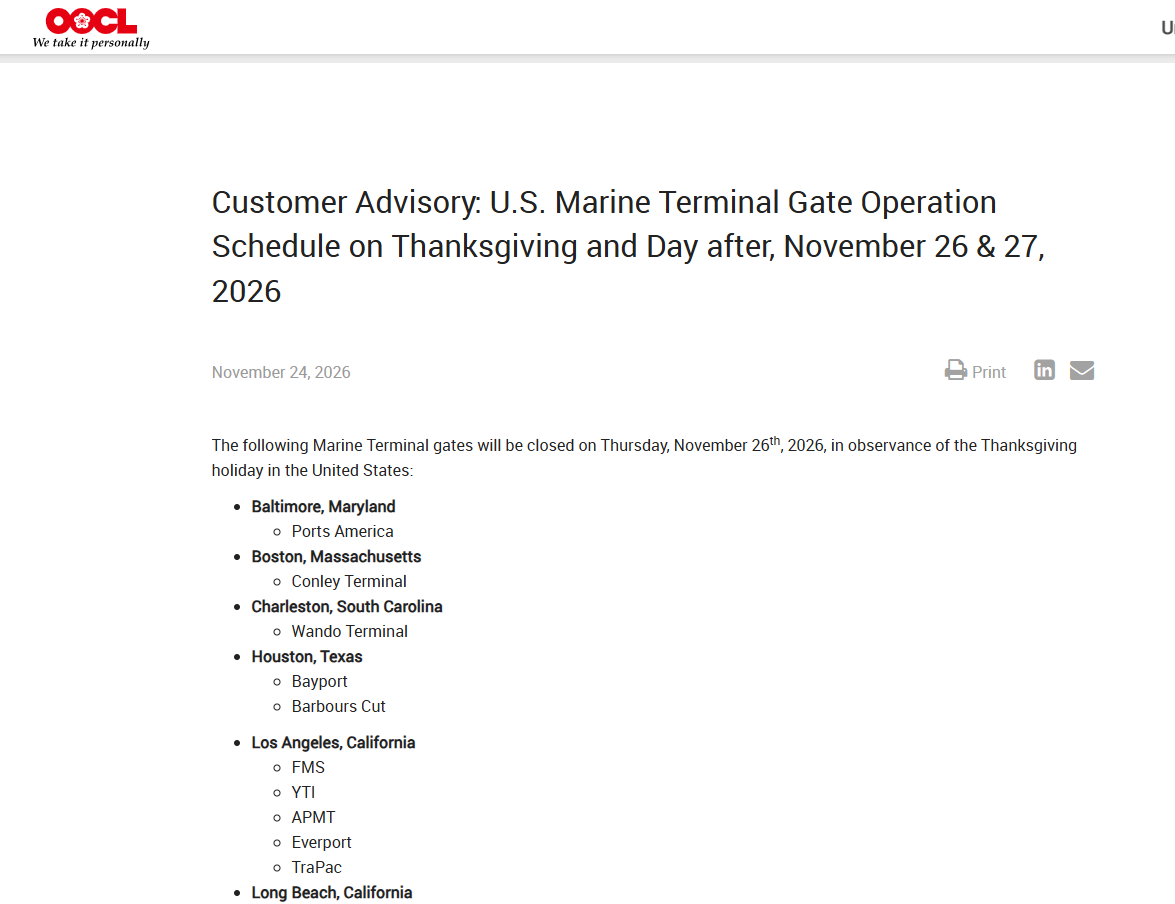
November 26, 2026 (U.S. local time) is Thanksgiving Day. Due to the holiday, container terminals at multiple major U.S. ports will suspend some or all gate operations on that day.
According to a customer notice issued by OOCL on November 24, the terminals involved include:
-Port of Los Angeles:FMS, YTI, APM, Everport, TraPac.
-Port of Long Beach:LBCT, PCT.
-Port of New York and New Jersey:APM Terminals, Maher Terminals, Port Liberty New York, and Port Liberty Bayonne.
-Other ports:Baltimore, Boston, Houston, Charleston, Miami, Oakland, Savannah, Seattle, among others.
Most terminals are expected to resume gate operations on November 27; however, certain terminals in Miami, Mobile, New Orleans, Seattle, and Tampa are still scheduled to remain closed on November 27.
TIPS
From the new round of U.S. trade policy to adjustments in port, rail, and holiday operations, the current pressures on international logistics stem not only from tariff changes but also from uncertainties in the transportation chain. Hanyue International will continue to monitor global trade policy, port developments, and changes in the international logistics market, providing customers with timely industry information and transportation references.