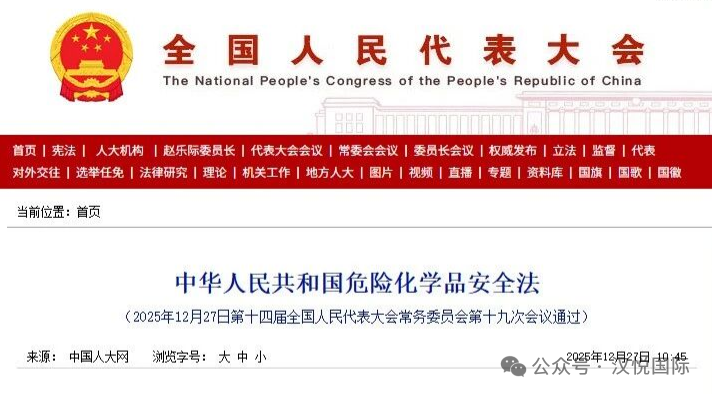
On December 27, 2025, the 19th meeting of the Standing Committee of the 14th National People's Congress officially voted to pass the "Law of the People's Republic of China on the Safety of Hazardous Chemicals".
Under the dual requirements of global industrial upgrading and domestic high-quality development, the importance of safety management of hazardous chemicals has risen to the level of national security and public safety.
The introduction of this law marks a new era in China's safety management of hazardous chemicals, shifting from reactive and focused supervision to a more proactive approach.
It, in the form of the rule of law, has built the most solid foundation to safeguard the safety of people's lives and property as well as the ecological environment.
Key Changes in the New Law
Legal hierarchy: The validity has been enhanced, rising from administrative regulations to national laws, with greater authority and binding force.
Chapter structure: A new chapter titled "Planning and Layout" has been added, strengthening source control; the "Registration and Emergency Rescue" section has been separated.
Management system: New provisions have been made for "three management and three musts" (managing industries, managing business operations, and managing production and operation must also involve safety management), strengthening the government's regulatory responsibility and the enterprises' primary responsibility. The responsibility system has become clearer and the supervision has become more comprehensive.
Directory Management: The emergency management department shall take the lead, and more departments (such as customs and market supervision) should be included. A "directory management system" should be established. The leading department should be clearly defined, and the coordination mechanism should be more complete.
Information-based supervision: It is required to establish electronic identification, implement full life-cycle information management, and conduct online inspections of major hazard sources. Promote intelligent supervision and enhance the ability of risk early warning.
Management of chemical industrial parks: A separate chapter is dedicated to the criteria for identifying chemical industrial parks, risk assessment, safety distances, and entry and exit management. The management of these parks is more stringent and systematic.
Legal liability: Significantly increase the fine amount (for example, for some behaviors, a fine of 5-10 times the value of the goods can be imposed), and increase the penalties for the directly responsible personnel. The enforcement intensity has been significantly strengthened, and the deterrent effect has been enhanced.
Transportation Safety: It is mandatory for vehicles to be equipped with satellite positioning monitoring systems. The driving duration is restricted (no more than 4 hours during the day, no more than 2 hours at night). The sale of highly toxic and explosive substances via the internet is prohibited. The control of transportation processes is more stringent and technologically advanced.
Registration and Emergency Response: New circumstances for exemption from registration have been added, and an information sharing mechanism has been clarified; in terms of emergency response, it is required that the plans be made public and the teams be jointly established. The registration process is more flexible, and the emergency response coordination is stronger.
Definition of Hazardous
Chemicals
Article 3 The term "dangerous chemicals" as used in this law refers to highly toxic chemicals and other chemicals that possess properties such as toxicity, corrosion, explosion, combustion, and support combustion, and which pose hazards to human beings, facilities, and the environment.
Scope of Application and
Main Responsibilities
Article 5 Enterprises, schools, research institutions, medical institutions, testing institutions, inspection institutions, and other units that produce, store, use, operate, or transport hazardous chemicals (collectively referred to as "hazardous chemical units") shall implement an all-staff safety production responsibility system, establish a dual-prevention mechanism for risk-based safety risk control and hidden danger investigation and governance, strengthen safety production standardization and informatization construction, and the main responsible person of each unit shall be fully responsible for the safety production of hazardous chemicals within the unit.
Dangerous chemical units must possess the safety conditions stipulated by laws, administrative regulations, as well as national and industry standards. They should establish and improve safety management systems and job safety responsibility systems, provide safety production education and training to their employees, provide them with labor protection equipment that meets national or industry standards, and participate in work-related injury insurance in accordance with the law. Employees must receive education and training, and only be allowed to work after passing the assessment; for positions with qualification requirements, personnel with corresponding qualifications must be appointed.
The safety management of civilian explosive materials, fireworks and firecrackers, radioactive substances, nuclear energy materials, and hazardous chemicals used in national defense research and production is not covered by this law.
If laws and administrative regulations have other provisions regarding the safety management of gas, those provisions shall be followed.
If the containers of hazardous chemicals are classified as special equipment, their safety management shall be carried out in accordance with the provisions of relevant laws and administrative regulations on the safety of special equipment.
Responsibilities of the
transportation department
Article 7 The transportation authority is responsible for the safety supervision and management of dangerous chemicals transported by road and waterways. It is also responsible for granting or filing licenses for dangerous chemicals transportation by road and waterways, as well as for the safety supervision of transportation vehicles. Additionally, it is responsible for the qualification certification of drivers, crew members, loading and unloading managers, escorts, declarants, and on-site inspectors for container loading of dangerous chemicals transportation enterprises by road and waterways.
02.Requirements for enterprises
Strengthen professional skills
The new law has set higher professional standards for the employees of hazardous chemical units, aiming to start from the source and mandatorily require them to possess basic professional qualities, thereby minimizing safety accidents caused by human factors to the greatest extent. The key points of its management mainly lie in the following three aspects:
Safety training: All employees must receive relevant safety education and training, and only after passing the assessment can they start working.
Qualification requirements: For positions with specific qualification requirements, the enterprise must employ professionals who have legally obtained the corresponding qualifications.
Educational qualification requirement: Employees of hazardous chemicals production enterprises need to meet the educational standards stipulated by the state.
Safety assessment certification
In addition, the newly enacted "Safety Law for Hazardous Chemicals" has also introduced a public disclosure system for safety assessment reports. "Production and storage enterprises of hazardous chemicals shall entrust institutions with the qualifications stipulated by the state to conduct a safety assessment of their own safety production conditions every three years. The safety assessment report must be made public in accordance with regulations." This requirement is a landmark measure to strengthen corporate responsibility and social supervision. This new regulation has changed the previous management model where only regulatory authorities conducted supervision over enterprises, shifting the supervision approach from a passive response driven by accidents to an active management under "social supervision". The public will also become an important supervisory element that helps enterprises continuously improve their safety levels.
SDS and Safety Label
Management
The new regulations place particular emphasis on two fundamental elements of chemical hazard information disclosure, namely the Safety Data Sheet (SDS) and the safety label. They also require enterprises to immediately announce any new hazardous characteristics of the chemicals they produce or import, and to promptly revise their SDS and safety labels. Although the new law does not specify a revision time limit, based on similar international experience, it is best to complete the update of the SDS and labels within 6 months to 1 year after the discovery of new hazardous characteristics.
03.Deeply refine the management rules
New registration exemption
rules
Article 87 of the new law has added a completely new exemption regulation for the registration of hazardous chemicals. The exemption mainly targets low-volume, low-release and low-exposure hazardous chemicals during the research and development, trial production and trial sales processes. Those hazardous chemicals that meet the requirements can be exempted from registration.
This means that for those chemicals with controllable risks and used for innovation, the complex registration procedures can be waived. This fully demonstrates the wisdom of the law in striking a balance between strict regulation and encouraging industrial innovation, providing more flexible management rules for the research and development of new materials and new technologies.
Classification of
hazardous chemicals
and dangerous goods
Article 64 and Article 65 of the newly revised "Safety Law for Hazardous Chemicals" once again distinguish the relationship between the concepts of "hazardous chemicals" and "dangerous goods". The new provisions clearly state that not all hazardous chemicals need to be transported as dangerous goods during transportation. For some hazardous chemicals whose risks have been reduced through proper handling, they can be transported as ordinary goods.
04.Strengthening of legal liability
Change in the
target of punishment
The penalties are centered on the units, with less emphasis on individual accountability; the "Dangerous Chemicals Safety Law" is the first to clearly stipulate the simultaneous penalties for "the directly responsible supervisors and other directly responsible personnel", achieving full coverage of the "double penalty system".
The fine amount has
been significantly increased.
Production/operation of prohibited chemicals
The range has been expanded from 200,000 yuan to 500,000 yuan (with a value of less than 100,000 yuan) to 300,000 yuan to 500,000 yuan (with a value of 100,000 yuan or more), and the value amount is 5 to 10 times (for values above
Using hazardous chemicals without obtaining a safety usage license
The range has been expanded from 10,000 yuan to 20,000 yuan to 10,000 yuan to 50,000 yuan. Failure to rectify within the time limit will result in the order to suspend production for rectification.
Overloading of hazardous chemical transportation
The range has been expanded from 50,000 yuan to 100,000 yuan, and then to 50,000 yuan to 500,000 yuan. It is clearly stipulated that vehicles must be equipped with satellite positioning
Extend regulatory
responsibilities
The new law extends regulatory responsibilities to government departments and relevant personnel. It clearly stipulates accountability clauses for acts of regulatory negligence, inaction, and misconduct. For instance, if the responsibility for planning and layout is not fulfilled or a coordination mechanism is not established, the directly responsible supervisors will be subject to disciplinary action in accordance with the law, thereby strengthening the initiative of government regulation.
Compared to the previous regulations, the "Dangerous Chemicals Safety Law" has achieved a profound evolution in the concept of safety governance. Its core essence can be summarized as: systematic governance, penetrating supervision, and closed-loop management. Han Yue International will closely monitor policy developments and simultaneously make preparations for alternative markets and backup supply chains to maintain flexibility. We will optimize the market layout, pre-plan alternative solutions, and enable shippers to maintain elasticity and resilience in the face of fluctuations. If you need the latest information or customized response plans, please contact our customer service.